In 2024, Chrysa Antonoglou travelled to Iraq on a trip that was part work, part discovery. It was there that the idea for her research took shape: what leads members of the diaspora to return to the land of their ancestors, and what happens once they are back? Two years later, that question became her master’s thesis in social anthropology at Panteion University in Athens, supervised by Katerina Rozakou. Drawing on interviews with five returnees and on what the diaspora says about return online, she follows their motivations, the obstacles they meet, and what they bring with them when they come home. The thesis was published in October 2026.
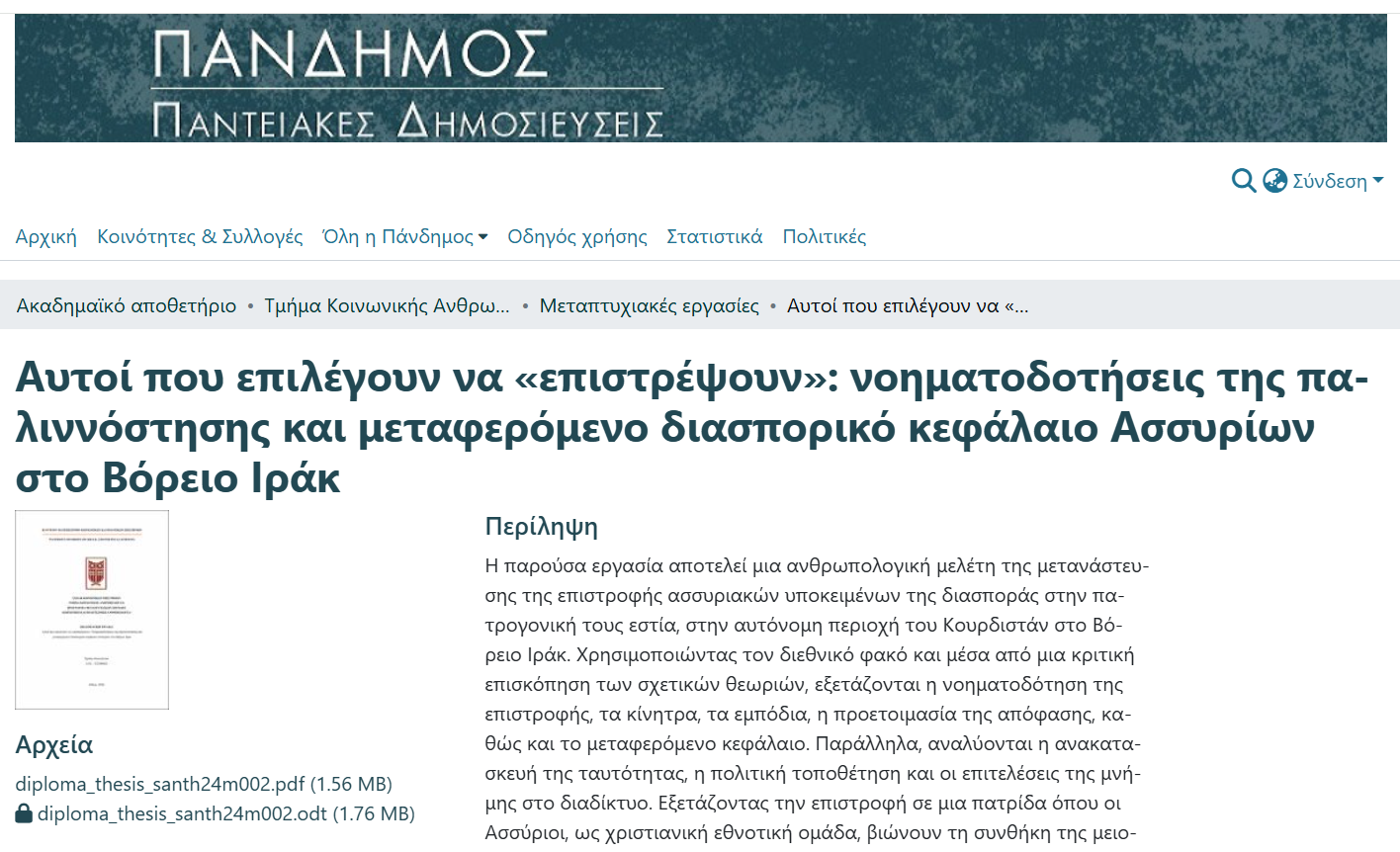
For the Assyrian Chaldean Syriac community, this is an important milestone. Until now, return was something families talked about, that a few pioneers lived, and that organisations like ours worked for. With this thesis, it becomes a subject of academic study, examined alongside the wider research on diasporas and migration. The movement gains a new dimension, and its relevance is confirmed by people whose job is to look at it from the outside. The official abstract is below, and the full thesis can be read online.
Summary
This study is an anthropological study of the return migration of Assyrian diaspora subjects to their ancestral homeland in the autonomous Kurdistan Region of Northern Iraq. Utilizing a transnational lens and a critical review of relevant theories, the study examines the conceptualizations attributed to return, the motives, obstacles, decision-making processes, and transferred capital. At the same time, it analyzes identity reconstruction, political positioning, and the performativity of memory in the digital space. By examining return to a homeland where Assyrians, as a Christian ethnic group, experience a minority condition under Kurdish administration, the study offers a fresh approach to the return migration of non-Muslim minority populations in the Middle East. This research relies exclusively on digital ethnographic research, which includes digital semi-structured interviews with five returnee diaspora subjects alongside non-participant digital ethnographic observation of social media and digital press. Digital ethnography is complemented by the biographical approach, inviting subjects to spontaneously narrate their journeys to and from the homeland, or from the diaspora to their ancestral home.
Ethnic return emerges as a fluid, polymorphic mechanism that surpasses classical typologies, as the experience remains heterogeneous. The primary motivation is not economic advancement, but rather the moral obligation to prevent demographic erasure, the need to belong among peers, with the decisive mobilization of the second generation now leading the first generation back home. Through the institutional positions and narratives of the subjects under study, return itself and identity are publicly reconstructed. Upon returning to their place of origin, returnees transfer capital, acting conditionally, as agents of change through a dynamic trajectory that requires maintaining transnational mobility and avoiding involuntary stasis. Meanwhile, the digital diaspora emerges as a heterogeneous field of memory performativity and contestation, where the desire for institutional organization and political assertion clashes with internal fragmentation and distance from the field.