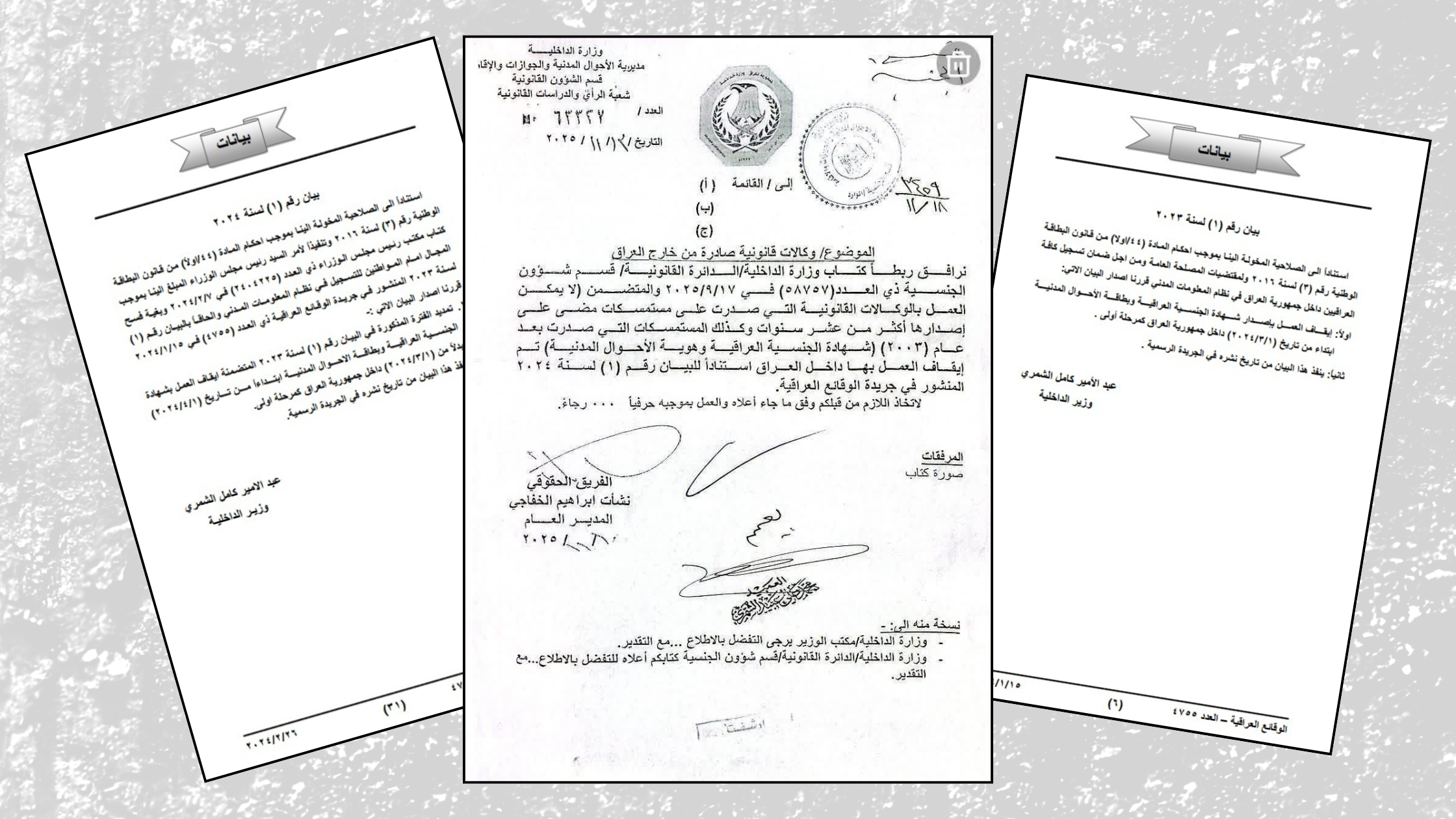
Recent regulations (Official statements and Letters) by the Iraqi Ministry of Interior, published in the Official Gazette (Al-Waqa’i Al-Iraqiya), have introduced a shift in how identity documents are handled inside Iraq.
What Changed?
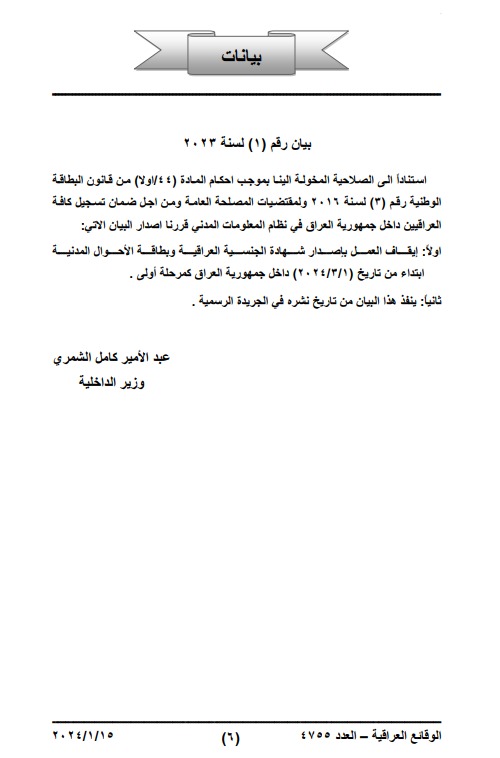
Under Statement No. (1) of 2023 by the Ministry of Interior, Gazette Issue (4755), published on 15 January 2024, Iraqi authorities announced that:
- The issuance of the two older documents, Iraqi Nationality Certificates (شهادة الجنسية العراقية) and Civil Status IDs (بطاقة الاحوال المدنية) would be stopped inside Iraq starting from March 1, 2024.
- These documents are being replaced by the Unified National Card (البطاقة الوطنية الموحدة).
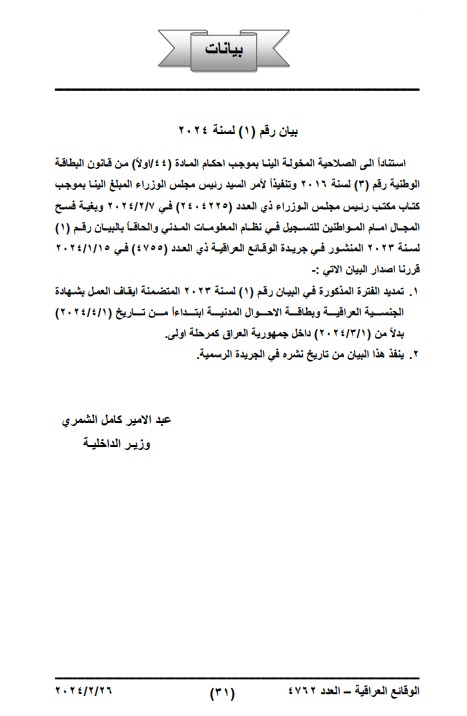
Thereafter, Statement No. (1) of 2024 by the Ministry of Interior, Gazette Issue (4762), extended the deadline to April 1, 2024, giving citizens more time to update their documents.
Additional Administrative Developments
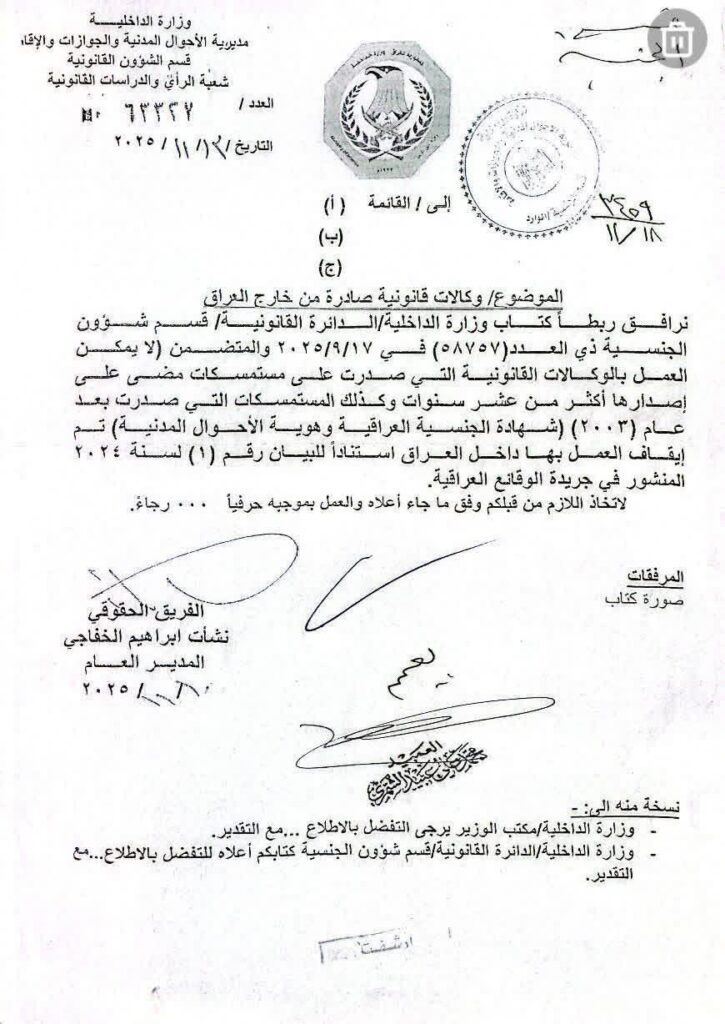
A document that circulated in the news, introduced further practical implications, the letter reported to be issued by the Department of Legal Affairs within the Directorate of Civil Status, Passports, and Residency of the Iraqi Ministry of Interior.
The letter, signed by the Director General Nashaat Ibrahim Al-Khafaji, and addressed to multiple entities (List A, List B, List C), with a copy to the Department of Nationality Affairs, refers to an attached communication from the latter.
According to the referenced letter from the Department of Nationality Affairs (Issue No. 58757, dated 17 September 2025), it was stated that:
- General powers of attorney (wakalat) issued based on identity documents that are more than 10 years old would no longer be accepted;
- Additionally, powers of attorney based on Iraqi nationality certificates and civil status IDs issued after 2003 would also be stopped from use inside Iraq;
- These measures were linked to the implementation of Statement No. (1) of 2024, published in the Official Gazette.
The covering letter itself is dated 13 November 2025 (Issue No. 63327), and its circulation in media outlets contributed to wider public attention, particularly among Iraqis living abroad who rely on consular powers of attorney.
Why This Matters for Iraqis Abroad
For many Iraqis living outside the country, these changes create real practical challenges, especially for those who rely on legal representatives inside Iraq.
Common issues include:
- Difficulty issuing or using powers of attorney
- Delays in property transactions, inheritance, or legal procedures
- Complications in registering children, marriages, or civil records
- Increased reliance on updated documentation that may not yet be accessible abroad
At the same time, it’s important to understand that this transition is part of a broader effort by the Iraqi government to modernize the civil registry system, centralize citizen data digitally, and reduce duplication and fraud in documentation.
Where the Gap Exists
The main challenge is not the policy itself, but the transition process.
Currently:
- The Unified National Card requires biometric data, which is mostly collected inside Iraq
- Many embassies and consulates do not yet have full capacity to issue the new card
- This creates a temporary gap where old documents are losing validity and new documents are not fully accessible abroad
Practical Recommendations
Rather than viewing this as a dead-end, there are real steps individuals can take to avoid complications:
1. Plan for Issuing the Unified National Card
If possible, traveling to Iraq to obtain the new card is currently the most reliable solution.
This allows you to fully update your legal identity records, avoid issues with powers of attorney also simplify all future administrative procedures.
2. Update Documents Early
If you still rely on the old Nationality Certificate and Civil Status ID, avoid waiting until they are rejected, begin renewing and updating to newer documentation where possible
3. Coordinate Carefully with Legal Representatives
Before issuing any power of attorney, confirm which documents are currently accepted and ensure compliance with the latest instructions inside Iraq.
4. Use the Updated Regulations as an Opportunity
For many Iraqis living abroad, these updates are not only an administrative change but also an opportunity to put their records in order. This includes properly registering family members, updating civil status details, and ensuring that all documentation is aligned with the current system.
More importantly, this process can serve as a meaningful point of reconnection with Iraq. Whether through a visit to complete procedures or renewed engagement with official institutions, it offers a chance to strengthen ties and secure a clearer legal and personal link for the future.
The shift toward the Unified National Card is a significant step in modernizing Iraq’s civil system. While the transition has created short-term challenges it also offers long-term benefits in terms of efficiency and security.
With proper planning and awareness, individuals can do their procedures effectively and even use it as an opportunity to strengthen their connection to Iraq.